Insights
A proven offshore success ready to take on another century
April 29, 2026
5 mins
This transfer of experience is becoming increasingly important as offshore projects move further from shore, grow in scale and complexity, and place higher demands on durability, lifecycle performance and operational efficiency.
Speaking about Jotun’s heritage and its relevance for today’s energy landscape, Kent‑Ove Sylte, Global Category Director, points to a legacy that stretches all the way back to the company’s founding.
“Our roots are firmly tied to corrosion protection,” said Kent‑Ove Sylte in a recent interview with RechargeNews. “That was where it all started for Jotun, and it remains the foundation of how we approach complex industrial challenges today.”
Since 1926, Jotun has developed coating solutions designed to protect assets operating in harsh and corrosive environments. Shipping, oil and gas became natural focus areas, particularly as offshore activity expanded in the North Sea from the early 1970s onwards. Being present from the industry’s early days helped build deep technical insight into long-term asset protection, maintenance strategies and lifecycle performance. The focus on R&D was at the core since the beginning.
This expertise has proven highly relevant as offshore wind developed – first nearshore, and later further out at sea.
“Whether it’s oil and gas or offshore wind, the environment is unforgiving,” Sylte explained. “Saltwater, wind, waves and limited access all place extreme demands on materials and protection systems. The fundamentals are very similar – protection has to work for decades, not just years.”
A piece of steel – and a piece of history
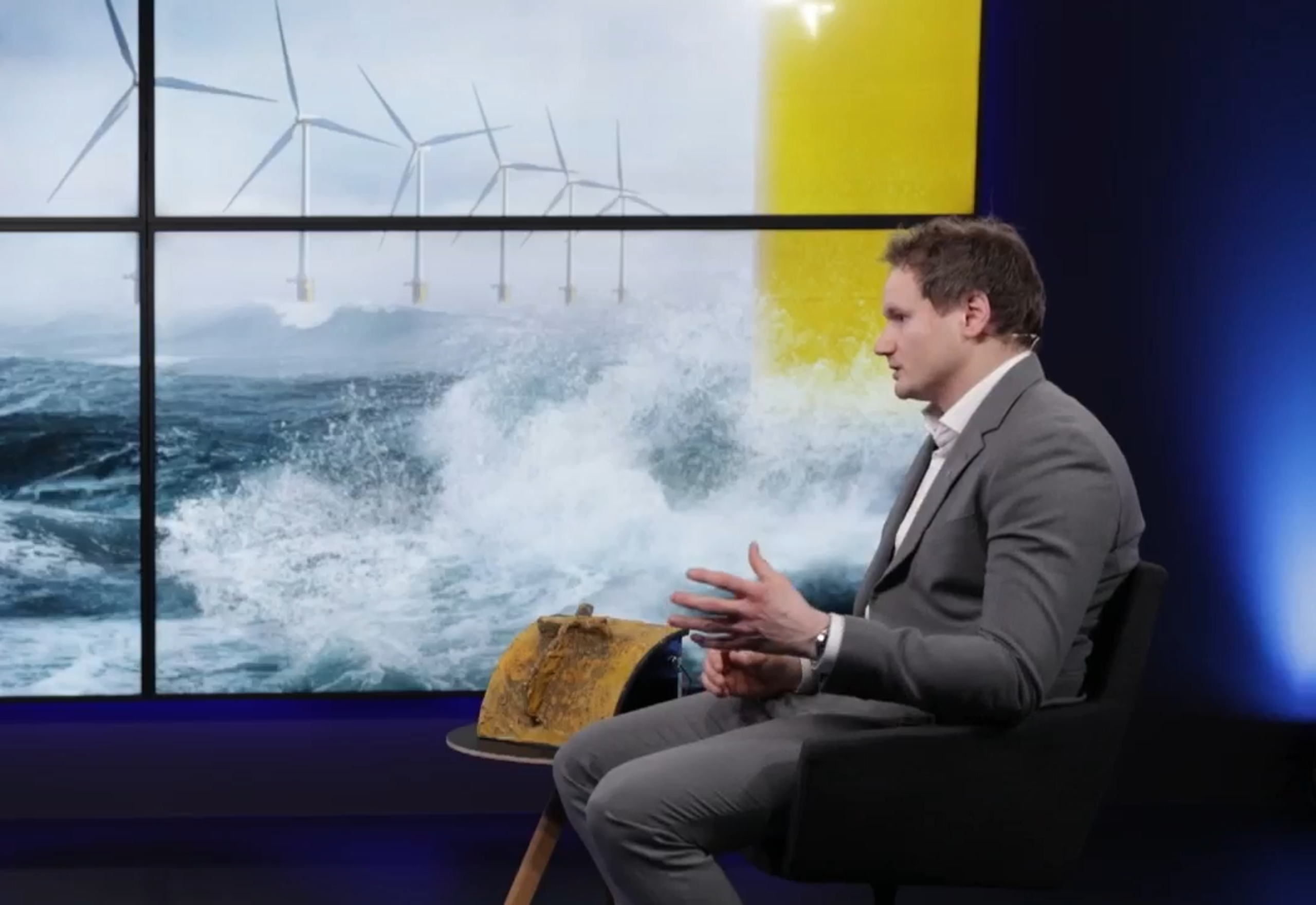
One striking illustration of long-term performance comes from a piece of steel originating from the Ekofisk field in the North Sea. The steel was part of an offshore jacket structure installed in the early 1980s and later removed during maintenance works after more than three decades in operation.
“When we examined the steel, we saw just how intact it still was after 35 years offshore,” said Sylte. “It’s a powerful confirmation of what well-designed coating systems can achieve in these environments.”
Extensive testing, including third‑party verification from DNV, confirmed that the steel had retained its integrity despite decades of exposure. For Jotun, this kind of real-world evidence reinforces the importance of durability, lifecycle thinking and long-term protection. These are principles that are becoming increasingly critical as offshore wind assets grow in size, complexity and distance from shore.
Balancing cost, performance and sustainability
Today’s offshore energy projects face a dual challenge. On one hand, capital expenditure must be controlled through efficient construction and installation. On the other, operational expenditure needs to be kept as low as possible over the asset’s lifetime.
“Maintenance offshore is expensive, and in some cases almost impossible to do, especially as projects move further out to sea,” Sylte said. “Reducing the need for intervention has a direct impact on operating costs, but also on safety and availability.”
Sustainability adds another layer of complexity. While offshore wind delivers renewable energy, the industry still carries a carbon footprint linked to manufacturing, installation and maintenance activities.
“Everything has an impact. Lowering the need for maintenance and extending service intervals is not just a cost issue – it also helps reduce emissions across the value chain,” Sylte added.
“Managing the project in an effective way from project start, with the right partners and right solutions from the beginning, will ensure both economic and environmental sustainability in both the capex and opex phase. And we have numbers to back it up.”
“Managing the project in an effective way from project start, with the right partners and right solutions from the beginning, will ensure both economic and environmental sustainability in both the capex and opex phase. And we have numbers to back it up.”
Kent-Ove Sylte
Global Category Director Steel Protection
“Managing the project in an effective way from project start, with the right partners and right solutions from the beginning, will ensure both economic and environmental sustainability in both the capex and opex phase. And we have numbers to back it up.”
Kent-Ove Sylte
Global Category Director Steel Protection
Larger turbines, greater complexity
Looking ahead, several trends are shaping how protection strategies are developed, which will only emphasise the importance of margins gains even more. Offshore wind turbines are growing rapidly in scale, with larger blades, taller towers and more complex structural components. At the same time, projects are moving into deeper waters where traditional fixed foundations are no longer sufficient.
“We are seeing a clear shift towards floating structures and more advanced designs,” said Sylte. “That increases technical complexity and makes access even more challenging. In those scenarios, protection systems must perform reliably for as long as possible, because intervention is simply not sustainable – not economically nor environmentally.”
As a recent example of the magnitude and complexity of such projects is the EOLMED floating offshore wind project outside of France - a 30 MW pilot farm with floaters designed by BW Ideol and manufactured / assemblied by MP Archimed. Jotun is the coatings partner for the project that will produce nearly 110 million kWh annually — enough to power 50,000 homes — and the project paves the way for future large-scale offshore wind farms in Europe.
“The floaters are massive steel structures measuring approximately 45m x 45m x 17m, including the demanding splash zone, which sets high demands to the coating on the external part,” said Xavier Pianezzi, Sales Manager for Energy and Infrastructure in Jotun.
For Jotun, this reinforces the importance of transferring decades of offshore experience into the renewable energy sector – adapting proven principles to new designs, materials and operating conditions.
As the offshore energy landscape evolves, Jotun’s role remains consistent: protecting critical assets so they can operate safely, efficiently and sustainably over time.
“Our experience from oil and gas is highly relevant,” Sylte said. “Enabling the future of energy doesn’t start from scratch. It builds on knowledge, technologies and lessons learned over many decades – and we see it as our responsibility to help carry that experience forward into new industries.”
From a century of corrosion protection to the future of floating offshore wind, the underlying challenge remains the same: Ensuring that structures exposed to the harshest environments can stand the test of time.
Watch the interview below.